
Taylor Trading Zone Calculator
Tomorrow's Trading Zone for ES, Nasdaq, & Nifty50
Know tomorrow's likely trading zone before the market opens based on Taylor's formulas, with an 8-year record of reliability. The pros use it, now so can you.
Where Will The Market Trade Tomorrow?
A critical part of technical analysis is knowing the zone where a market is likely to trade. The value of the Taylor trading technique lies in its ability to provide this information. Calculating the likely market range for the next session (or within the current cycle) is determined by measuring the price ranges of lows to highs and highs to lows. Using these variances of market rise and fall averaged over a range of trading days, Taylor created an  algorithm of 12 calculations to predict support, resistance, & the trading zone for the following day (in the case of a stock or future). This algorithm is the heart of the Taylor trading technique. The measurements comprising the algorithm were pioneered by George Taylor in the 1950’s, hence the name Taylor trading technique. Since then, the algorithm has proven applicable to virtually all tradeable markets, and is an important tool, in addition to candlestick patterns, used by most professional market traders.
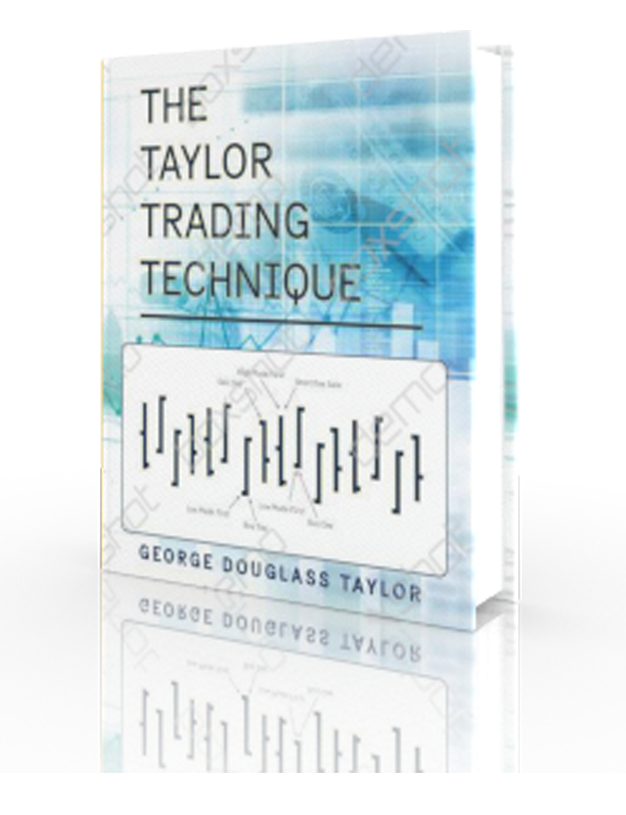
Taylor’s book is available at bookstores and on Amazon. To learn how to calculate the formulas, you can try to figure them out from the book, but traders find the book extremely difficult to understand and the calculations, although difficult to formulate, are not provided. The formulas that comprise the Taylor trading technique are also not taught at other trading schools (they don’t know how) if you can find them at all.
“Like A Crystal Ball For Traders”
Professional traders use the Taylor trading technique each day in the markets they trade, giving them the “edge”. They know the day’s support, resistance, and trading zone. The Taylor trading technique calculations are averages of averages, and the formulas are not available to the average trader.
Your Daily Taylor Trading Zone—Automatically Calculated
 Spend less time updating a spreadsheet and more time preparing for the market.
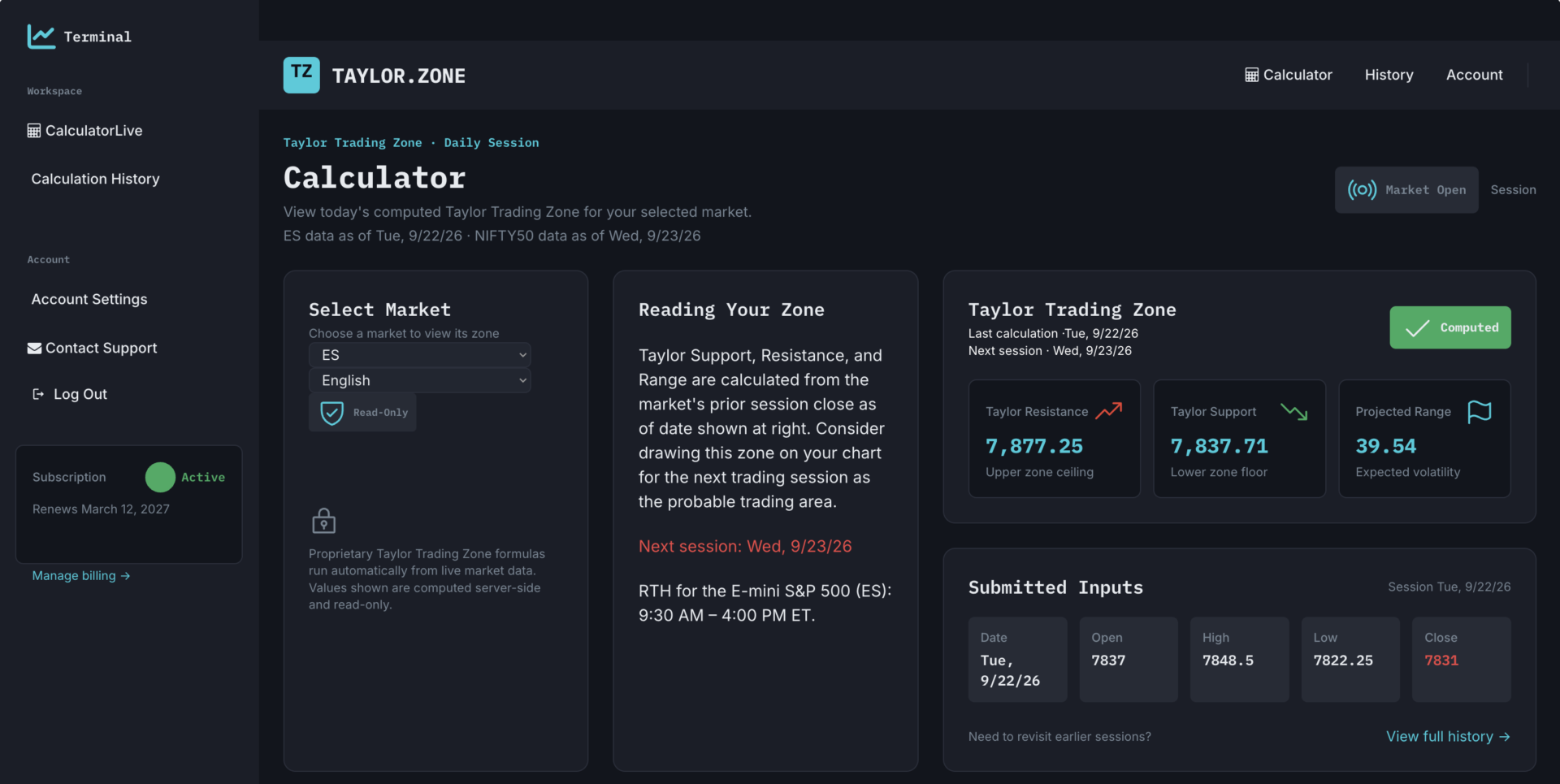
The new Taylor Trading Zone brings the convenience of automation to the original Excel-based Taylor Calculator. Instead of entering dates and market prices yourself, simply log in, select your market, and view your calculated Trading Zone.
No spreadsheet to maintain. No daily OHLC entry. Your market data and Taylor levels are provided automatically.
Make daily market preparation easier with the automated Taylor Trading Zone. You get Taylor Support, Taylor Resistance, and Projected Range for ES, Nasdaq, and Nifty50 in one convenient web app. Market prices and calculations update automatically after each market’s regular session closes—no Excel spreadsheet or manual data entry required.
The New, Automated TaylorTradingZone App Dashboard
And here’s what Dan said about the Taylor calculator
Ever since Taylor developed his “book method” over 75 years ago, traders who have learned its secrets are amazed by its accuracy to forecast prices. But only a very few traders have been able to do so, because Taylor’s method is so difficult to calculate and requires multiple formulas. These formulas, priceless, reveal the most important information every trader wants to know: where are prices likely to trade in the future. For day traders, that’s the next session.
Now, it’s your turn. Use George Taylor’s Trading formulas in the new, automated, Taylor Trading Zone.
The Taylor Trading Technique – Forecasting Tomorrow’s Trading Zone
The Taylor trading technique is a mathematical model predicting where a market is likely to trade in the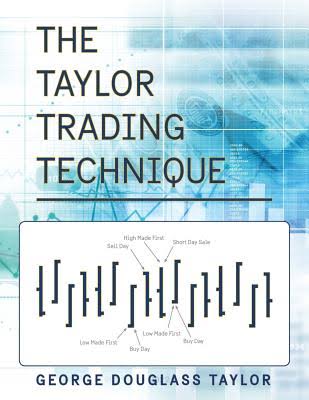 future. George Taylor studied price movements in several grain markets waaaay back in the 1950’s. Taylor measured market movements from lows to highs and again from highs to lows. His studies confirmed two things, each quite remarkable:
1. Markets are engineered both up and down by degrees by the market makers (who were grain sellers). The objective that these market makers wanted to achieve was to sell their product for the highest prices when the grain came to market in the future. His book, Taylor Trading Technique, details how this was done.
2. Every market exhibited the same type of movement. From his observations, Taylor was able to develop a mathematical model to predict market price movements in the near future.
Why You Need The Taylor Trading Technique Calculator
Taylor’s Trading Technique is like having a crystal ball to know where the market is likely to trade. Most S&P futures day traders can’t possibly calculate Taylor’s numbers because the formulas are so difficult, as this video explains. After years of study, I’ve learned the multiple calculations that comprise Taylor’s trading zone and entered them into an excel spreadsheet. Now, you can have the same Taylor numbers that have been available only to professional traders.
This video explains Taylor’s calculations